
On July 13, 2026, CMS released its quarterly refresh of the four guides that govern Medicare Secondary Payer reporting and Workers’ Compensation Medicare Set-Asides. Updated: the Section 111 NGHP User Guide, the Section 111 GHP User Guide, the GHP Defense Reference Guide, and the WCMSA Reference Guide.
If you have been waiting for a quarter with real policy shifts, this is not it. There are no new review thresholds, no policy overhauls, and nothing that changes the fundamentals of how Medicare liens or set-asides are handled. What did land is a handful of administrative changes, some of which touch reporting workflows enough that they are worth knowing about. Here is the plain-language walkthrough.
NGHP User Guide (v8.5): The automated email nudges are gone
The Non-Group Health Plan (NGHP) User Guide covers Section 111 reporting for liability, no-fault, and workers’ compensation claims. That is the majority of what shows up on plaintiff personal injury files.
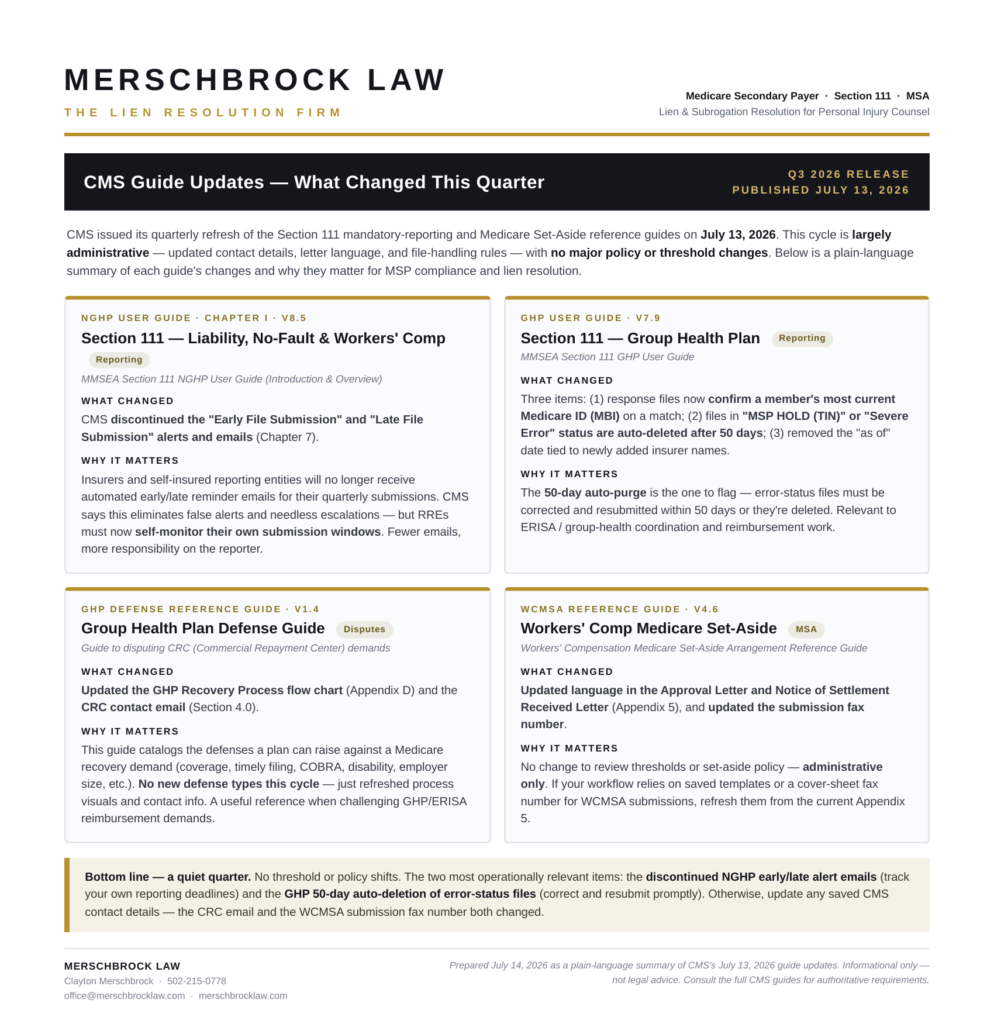
In this release, CMS discontinued the “Early File Submission” and “Late File Submission” alerts. CMS’s stated reason is that the alerts produced too many false positives and generated unnecessary escalations. The practical effect is that insurers and self-insured Responsible Reporting Entities (RREs) no longer receive automated reminders about their quarterly submission windows. They have to track those deadlines on their own.
For plaintiff firms, the takeaway is straightforward. If you have been relying on a carrier’s timely Section 111 reporting to kick off Medicare’s recovery process on your case, one of CMS’s automated backstops just went away. Carriers that were already slow to report are now slower.
GHP User Guide (v7.9): The 50-day auto-purge is the one to watch
The Group Health Plan (GHP) User Guide governs Section 111 reporting for employer and union health plans, which is the coverage behind most ERISA and group-health reimbursement demands. Three changes this cycle:
- Response files now confirm a member’s most current Medicare ID (MBI) when a match is found
- Files sitting in “MSP HOLD (TIN)” or “Severe Error” status are automatically deleted after 50 days
- The “as of” date tied to newly added insurer names was removed
The 50-day auto-purge is the one to flag. If a file goes into error status and does not get corrected and resubmitted within that window, it disappears. There is no notification, no grace period, no way to recover it later. If your case depends on GHP reporting getting through, and it lands in error status, the clock is now running.
GHP Defense Reference Guide (v1.4): Refreshed process map
This guide catalogs the defenses a plan can raise when the Commercial Repayment Center (CRC) demands repayment of a mistaken primary payment. Coverage, timely filing, COBRA, disability, employer size, and the rest.
This update refreshed the GHP Recovery Process flow chart and the CRC contact email. No new defense types this cycle. If you keep this guide in your reference file, swap in the updated versions. Nothing changed about the defenses themselves.
WCMSA Reference Guide (v4.6): New letter language and a new fax number
The Workers’ Compensation Medicare Set-Aside guide saw updated language in the Approval Letter and the Notice of Settlement Received Letter, and CMS issued a new submission fax number.
Review thresholds and set-aside policy are unchanged. If your firm keeps templates or a saved cover sheet with the WCMSA fax number, pull the current Appendix 5 and update accordingly. That is the whole update.
The bottom line
Q3 2026 is a maintenance release. Nothing here changes how a Medicare lien gets negotiated or how a set-aside gets priced. The two items most likely to touch a plaintiff firm workflow are the discontinued NGHP email alerts, which put more of the reporting-timeline burden on the carriers themselves, and the GHP 50-day deletion of error-status files, which requires faster error resolution than most plans are used to. Beyond that, the CRC contact email and the WCMSA submission fax number both changed, so update your saved contacts.
Why this matters for your cases
CMS refreshes these guides every quarter, and the details are exactly where reimbursement disputes get won or lost. Even in a quiet quarter like this one, the small procedural shifts add up over the year. If you have a case with a Medicare or MSP wrinkle and want a second look before settlement, I handle Medicare lien resolution nationwide. Contact me at office@merschbrocklaw.com.
This post is a plain-language summary of CMS’s July 13, 2026 guide updates and is for informational purposes only. It is not legal advice. For the authoritative requirements, consult the full CMS guides at CMS.gov.